








Japan’s Top 100 lawyers plus 20 Legal Icons, Miran Lim and Brian Yap report
As one of the world’s most industrialised economies, Japan appears to be facing a development paradox in tackling a weakening currency while experiencing an unstoppable flow of inbound tourism – a trend that is too much for the country to sustain.
Despite grappling with economic contraction marked by a fall in private consumption and corporate spending in the first quarter of this year, Japan has outperformed many of its regional and global peers in the equity capital market space in the past year. Since April last year, Japanese stocks have rallied strongly, surpassing many global peers, recording 18.5% in 12-month returns and lagging only the 23.1% generated by US equities, according to the London Stock Exchange Group.
Attracted by Japan’s stable regulatory environment and weakened yen, global private equity giants such as Carlyle Group, Blackstone and KKR have been doubling down on their investment in the country amid ongoing geopolitical tensions in the region.
Carlyle, for example, announced in late May that it had raised JPY430 billion (USD2.8 billion) for its fifth Japan buyout fund, making it the US private firm’s largest investment vehicle for Japan.
Around the same time, the US private equity group publicised its move to take Tokyo-listed KFC Holdings Japan private via a USD835 million acquisition with a tender offer period set to run through to 9 July this year. Blackstone has also reportedly agreed to acquire the Tokyo-listed digital comic book provider Infocom in a deal totalling USD1.66 billion, while KKR-owned Logisteed has made a tender offer for Tokyo-listed global integrated logistics company Alps Logistics.
On the legal front, the country also recently passed and implemented several amended laws covering areas including personal data and trade secret protection, as well as the tender offer system and intellectual property. Some of those amendments are a response to several regulatory problems and legal loopholes, including a recent increase in cases involving the unauthorised acquisition of trade secrets stored in Japan.
Under the amended Unfair Competition Prevention Act, Japanese companies can now file lawsuits with a Japanese court when an overseas violation of their trade secrets has occurred, and Japan’s antitrust law will apply.
Another major regulatory change has been recent amendments to the Financial Instruments and Exchange Act, tightening areas including the regulation of takeover bids. Under the revised law, companies accumulating shares of a listed company via the public market will now be subject to a mandatory tender offer requirement if the level of voting rights acquired exceeds 30%.
Against this backdrop of opposing economic trends and significant regulatory changes, we present our annual A-List of the top 100 lawyers practising in Japan – including foreign legal consultants, advisers and counsel. The A-List is based on extensive research conducted and nominations received from in-house counsel based in Japan and elsewhere, as well as from Japan-focused partners at international law firms.
As of 1 June, there were 45,776 Japan-qualified lawyers, with 9,214 being female, according to the Japan Federation of Bar Associations. Additionally, there were close to 500 registered foreign attorneys in the country.
Nearly all the A-List lawyers are strategically located in Tokyo, the epicentre of the country’s legal and commercial activities.
Comments submitted to Asia Business Law Journal by clients suggest that many clients put a premium on Japanese and international law expertise, particularly in specific and new areas of business and legal compliance, with a strong understanding of Japanese culture.
Long-term dedication
In Japan, continuity and certainty are deeply ingrained in the culture and have traditionally been deciding factors in shaping relationships, particularly those in the business world. Japanese corporate executives, therefore, hire their external legal advisers based on those two qualities, with long-lasting working relationships deriving from trust built over time.
Masahiko Ishida, the managing partner of DLA Piper in Japan, is an experienced lawyer with these qualities who has been singled out for providing continuity and certainty to his clients through long-term dedication to executing legal mandates. He is recommended by Yuya Hajikano, project manager at Kansai Electric Power Company, who appreciates Ishida’s comprehensive strategies to address legal issues facing his company.
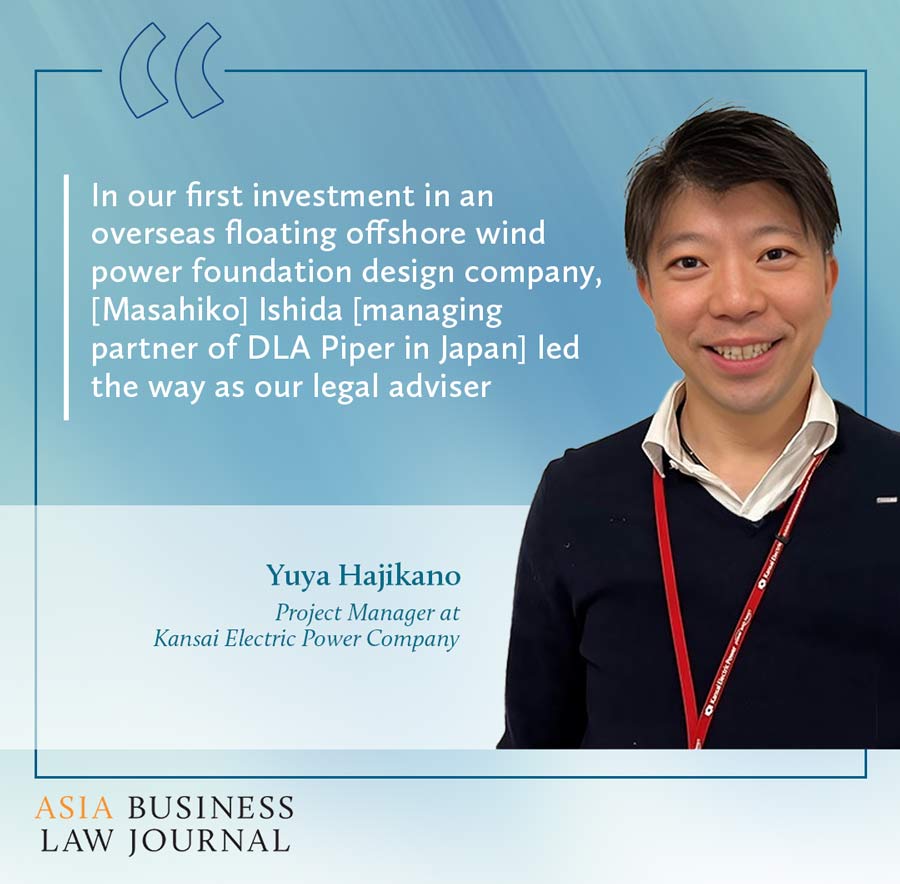
“In our first investment in an overseas floating offshore wind power foundation design company, Mr Ishida led the way as our legal adviser in conducting due diligence on various contracts and negotiations with the counterparty,” says Hajikano.
Culturally adept
For overseas-qualified lawyers practising in Japan, an unmatched knowledge of international laws and regulations both in general and in specific sectors is undoubtedly integral to their advice to Japanese clients. But, equally, a deep understanding of Japanese corporate culture is a must for one to stand out among the 500-strong community of registered foreign attorneys in Japan.
Mark Davies, a partner at King & Spalding in Tokyo, is one such lawyer with decades of legal experience practising in Japan complemented by “extremely high communication skills in Japanese”, according to Takanori Ueki, the chief executive of Eastbridge Renewable. Ueki calls Davies “a bridge between the overseas and the domestic market”.
“[Davies] has the most wind power generation-related knowledge in the Japanese market, particularly when it comes to wind turbine procurement, in that he has experience in such procurement from GE, Vestas, Siemens, Senvion and all original equipment manufacturers,” adds Ueki.
A high level of local knowledge also needs to be complemented by an equally high level of work quality. Shinji Niioka, a former general counsel of Mitsubishi Fuso Truck and Bus Corporation, believes Nishimura & Asahi’s Tokyo-based partner, Lars Markert, is one such lawyer, providing “excellent” work quality and legal advice that can be relied on “anytime to the fullest”.
“His experience in multiple jurisdictions as well as his strategic and structured way of advice helped the company tremendously,” says Niioka.
Koh Swee Yen, a senior counsel and partner at WongPartnership in Singapore, also points to Markert’s work ethic, describing him as “a top legal mind” with “absolute” dedication to the practice of law.
“[Markert] is reliable, trustworthy and always makes that special extra effort,” says Koh.
At the forefront
In the digital age, new types of technology are cropping up while existing ones are evolving, leading to a constant introduction of laws that add to the regulatory compliance burden on companies.
This ever-increasing burden has led to a greater demand for updated legal advice, and only lawyers at the forefront of developments can respond effectively to such needs.
To Yusuke Ishimori, the chief producer at Sony Music Solutions, says Mori Hamada & Matsumoto partner Masafumi Masuda is, without doubt, a lawyer at the forefront. “He possesses legal knowledge of the changing environment, such as NFT [non-fungible token], AI and Web3, and flexibly introduces case studies and risk points to us clients,” says Ishimori.
From the perspective of Suntory Holding’s general manager, Chihiro Mamiya, Masuda is not only at the forefront, but is also a “fortune teller”.
“He has always responded promptly, accurately and politely to our requests for advice on NFT matters, which are an unknown area to us as clients,” says Mamiya.
The luminaries
Also, for the first time in our A-List, we celebrate Japan’s Legal Icons, 20 in total, who are titans and rainmakers in Japan’s legal sector and lead the country’s most admired law firms or legal teams as mentors.
One such senior legal figure is Akihiro Wani, senior counsel at Greenberg Traurig in Tokyo. Wani, who joined Greenberg Traurig as a senior counsel from Morrison Foerster last year, is a banking and financial markets regulatory veteran with a decades-long legal career including senior roles at Mitsui, Yasuda, Wani & Maeda and Linklaters.

Wani, who specialises in advising on derivatives and structured finance transactions, acted on the first public offering of credit-linked securities in Japan. Tomoko Morita, the head of the Tokyo office at the International Swaps and Derivatives Association, refers to the financial regulatory veteran as a “pioneer in Japan’s derivatives market”. “[Wani’s] expertise and unwavering dedication to the field have been essential to its current growth and development. He consistently possesses forward-thinking ideas and provides advice from a practitioner’s perspective,” says Morita.
Naoki Kinami, a senior adviser at Vanguard Lawyers Tokyo, is another legal industry veteran who has made his mark on the profession in Japan. Admitted as an attorney in Japan in 1975, and to the New York bar in 1980, Kinami has a legal career spanning more than 40 years specialising in international finance, corporate M&A and regulatory matters.
With his experience representing financial institutions in cross-border and domestic transactions, including structured loans, the finance veteran has established a wide network of clients including major global commercial banks and Japanese insurance companies.
Compiling the A-List
The A-List is based on extensive research conducted by Asia Business Law Journal. To identify the top lawyers in Japan, we turned to thousands of in-house counsel in Japan and around the world – as well as partners at international law firms – and asked them to tell us which lawyers should make the cut.
A-List lawyers were defined on the nomination form as “lawyers who are currently the star performers of Japan’s legal profession; the lawyers who are personally undertaking the country’s top legal work, crafting the most cutting-edge legal solutions to complex problems, and setting the highest standards in terms of quality, innovation and the ability to handle complex matters”.
Our Legal Icons were defined as “lawyers who are the luminaries of Japan’s legal profession; the titans who command the respect of clients and juniors alike; the mentors who lead Japan’s most admired law firms and/or legal teams, and who are the country’s most prolific rainmakers”.
All Japanese private practice lawyers and foreign lawyers based in the country were automatically eligible for inclusion in the nomination process. There were no fees or any other requirements for entry.