





Sponsored Feature
02 October 2024
Three factors shaping the future of Hong Kong arbitration
Legislative innovations, technological advancements and a dynamic legal infrastructure continually reinforce Hong Kong as a premier arbitration hub. As global interest in arbitration intensifies, Hong Kong is evolving its arbitration framework to changing international dispute resolution demands.
This article explores three significant factors shaping the future of arbitration in Hong Kong: the Hong Kong-Mainland China Interim Measures Arrangement, updates to the Hong Kong International Arbitration Centre’s (HKIAC) Administered Arbitration Rules, and the use of technology to support proceedings. Through these lenses, Opus 2 provides insights into the city’s evolving arbitration landscape and its implications for practitioners.
1. The Hong Kong-Mainland China interim measures arrangement.

Business Director, APAC
Opus 2
Tel: +852 9876 6270
Email: bdapac@opus2.com
The Arrangement Concerning Mutual Assistance in Court-Ordered Interim Measures In Aid of Arbitral Proceedings by the Courts of Mainland and of the Hong Kong Special Administrative Region is a groundbreaking framework enhancing cross-border dispute resolution. The arrangement enables parties involved in Hong Kong-seated arbitration and administered by recognised institutions, including the HKIAC, to request interim measure from mainland China courts, just as parties in mainland China arbitration can seek interim measures from Hong Kong courts under Hong Kong law. These measures can include preservation of assets, evidence and conduct before the final arbitral award.
Latest figures from HKIAC show that since the arrangement’s October 2019 implementation, the HKIAC has processed 132 applications for interim measures, with 126 concerning the preservation of assets. This underscores the arrangement’s efficacy in asset protection and the enforceability of arbitration awards.
“HKIAC has unparalleled experience facilitating applications for interim measures to the mainland Chinese courts,” said HKIAC Secretary General Joanne Lau. “This further demonstrates HKIAC’s strengths in handling inbound and outbound China disputes, without losing sight of our international role and connections, which are of course equally important.”
The arrangement’s influence is expected to deepen, further streamlining dispute resolution processes and fostering greater integration between Hong Kong and mainland China. This trend positions Hong Kong as a more attractive venue for international arbitration, aligning with the increasing demand for effective cross-border legal solutions and enhancing the city’s global competitiveness.
2. Update to HKIAC’s Administered Arbitration Rules.
On 1 June 2024, the HKIAC introduced significant updates to its Administered Arbitration Rules, reflecting contemporary arbitration practices and addressing emerging challenges. These updates focus on key areas like environmental, social and governance (ESG) considerations; diversity initiatives; technology and information security; and procedural efficiency.
- Diversity and inclusion. The new rules encourage parties and arbitrators to consider diversity in appointments. The HKIAC is also mandated to uphold this principle when exercising its appointment authority. This initiative promotes inclusivity and reflects a broader commitment to diversity within the arbitration community.
- Environmental considerations. The updated rules incorporate ESG principles by requiring tribunals and parties to consider environmental impacts in arbitration procedures. Tribunals now have the discretion to factor in adverse environmental impacts when allocating costs, reflecting the HKIAC’s commitment to sustainability and aligning with broader industry trends.
- Information security. With heightened data protection concerns, the new rules emphasise the importance of information security in arbitration. Tribunals and parties are obligated to implement robust security measures, and tribunals have the authority to impose sanctions for breaches. This focus ensures adherence to global best practices in safeguarding sensitive information.
- Efficiency enhancements. The updates also aim to improve arbitration efficiency. Enhanced tribunal powers for determining preliminary issues and streamlined procedures aim to reduce delays and optimise procedural processes, reinforcing the HKIAC’s ongoing efforts to enhance arbitration efficiency.
Proactive updates to the HKIAC’s proactive Administered Arbitration Rules highlight its leadership in the arbitration field, setting high standards and addressing emerging challenges.
“The 2024 rules introduce several new provisions to reflect advancing social norms and technological developments, however they are largely a refinement of the 2018 rules,” Lau said. “The overall aim is to improve the time- and cost-efficiency of HKIAC arbitration while maintaining the ‘light touch’ administration for which HKIAC is known.”
3. Integration of technology and the continued use of virtual and hybrid proceedings.
Adopting virtual and hybrid arbitration hearings has become a defining feature of Hong Kong’s arbitration landscape. The covid-19 pandemic accelerated the shift towards remote proceedings, which has continued in the post-pandemic era.
Hong Kong has multiple venues with advanced technology to support virtual hearings, including high-definition video-conferencing and dedicated virtual hearing rooms. This ensures virtual hearings are conducted with the same level of professionalism and efficiency as in-person sessions.
In addition, Opus 2 recently opened a central Hong Kong office to meet growing demand. As the global leader in hearing technology and services, the expansion leverages the company’s years of experience in the region and provides increased continuity for the international arbitration community.
The Hong Kong judiciary supports virtual hearings, reinforcing their legitimacy and practicality. Recent court decisions have emphasised the appropriateness of virtual hearings, particularly in light of logistical challenges and travel restrictions. This judicial support has further cemented virtual and hybrid arbitration’s acceptance as a viable option in Hong Kong.
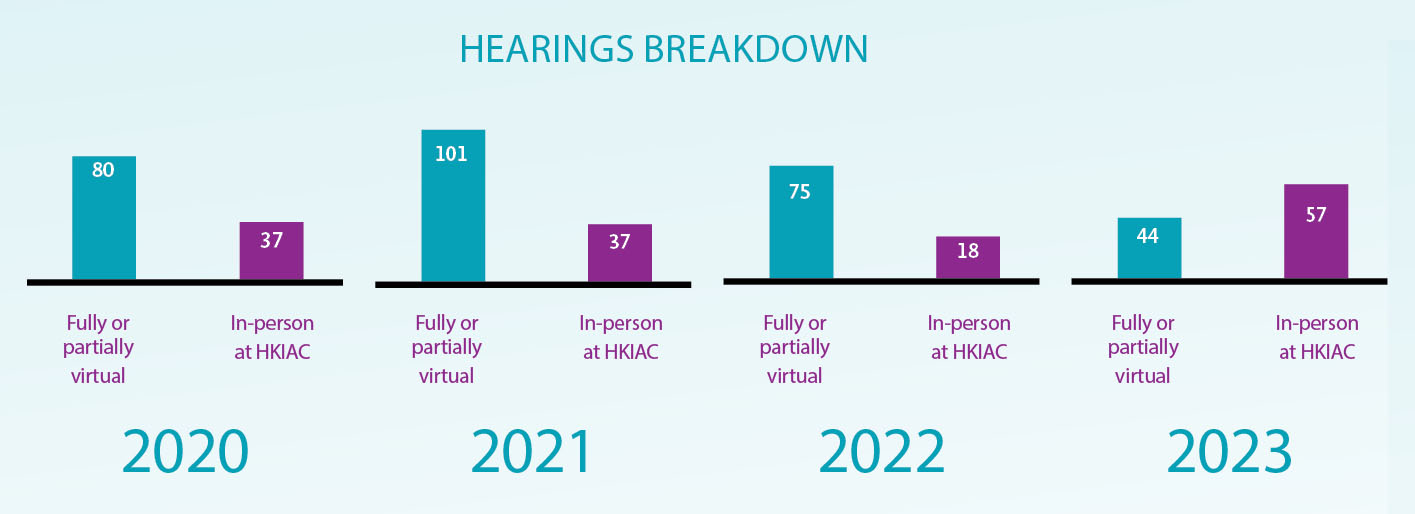
HKIAC statistics reflect a significant utilisation of virtual hearings. In 2023, a substantial number of virtual hearings were fully or partially conducted, demonstrating the ongoing adoption of technology in arbitration. This trend underscores the increasing integration of virtual and hybrid proceedings, including the remote delivery of transcripts, in Hong Kong’s arbitration ecosystem.
“As one of the very first institutions to launch a dedicated virtual hearing suite at the beginning of the covid-19 pandemic, HKIAC continues to adapt and innovate,” said Lau. “Demand for HKIAC’s online case management system is increasing and we continue to monitor the adoption of artificial intelligence across the industry.”
Technological advancements play a crucial role in arbitration proceedings’ efficiency and effectiveness. In Hong Kong, various technologies are employed to enhance the arbitration process, including:
- Online legal case management platforms to facilitate secure document sharing, scheduling and hearing logistics to ensure seamless communication and coordination among participants.
- Virtual hearing rooms equipped with high-quality video-conferencing capabilities to simulate the in-person hearing experience, providing a reliable and immersive environment for virtual sessions.
- Electronic bundling and electronic presentation systems that digitise and manage large volumes of documents, enabling real-time presentation and annotation.
- Real-time transcription services to provide instant, verbatim text of spoken words and support accurate and immediate record keeping.
- Secure communication channels using encryption to protect sensitive information and maintain confidentiality.
Conclusion
Hong Kong’s arbitration landscape is evolving to meet the demands of a dynamic legal environment. The Hong Kong-Mainland China arrangement updates to the HKIAC’s Administered Arbitration Rules and the integration of advanced technology are key factors shaping the future of arbitration in the city.
As Hong Kong continues to innovate and adapt, it reaffirms its status as a leading global arbitration hub.
Opus 2’s expansion and regional expertise underscore our commitment to advancing arbitration practices and contributing to Hong Kong’s evolving arbitration ecosystem.

Opus 2
1609, Nexxus Building
41 Connaught Road
Central, Hong Kong
Tel: +852 9876 6270
Email: bdapac@opus2.com
www.opus2.com