







How much should you be paying for legal advice in India?
Five years ago, Ashok Sharma, now president of the Indian Corporate Counsel Association, welcomed India Business Law Journal’s initiative to publish Indian law firms’ billing rates. The first survey, Sharma said, would “go a long way towards establishing transparency and dispelling many myths surrounding hourly billing rates”.
Over the past five years, we have received unwavering support from in-house counsel at companies such as Videocon Industries, Jones Lang LaSalle, Yum! Brands, Dabur, Intercontinental Hotels, Siemens, Federal Express, Turner General Entertainment, CRISIL, Wockhardt, Bombardier Transportation, Times of India, Nestlé India, DHL International and Bharti Enterprises, as well as encouragement from prominent lawyers and business executives for our research.
Such solid backing has spurred us on. This year, again, corporate counsel offered vociferous support for India Business Law Journal’s sixth annual survey to promote billing transparency and accountability. Shruti Dvivedi Sodhi, director of legal at Colt Technologies, says a list of legal fees “will be very welcome and will give a fair idea of the rates across firms and engagement models”.
 Rohit Dave, general counsel at SRS Investment Advisors, which spends roughly US$500,000 on legal fees every year, agrees. “Yes, it would be good because as of now, you only discover the hourly rates if you work with or approach a law firm and not otherwise.” He notes that these rates are often not cast in stone and vary, depending on the relationship and size of the matter.
“Publishing rates will certainly be helpful,” says Vivek Mittal, legal counsel at Lupin Pharmaceuticals. He adds, however, that comparing published rates with actual billing would be an interesting exercise in assessing transparency levels. “I think a lot of law firms use the rack rate concept, which represents their highest rate,” says Mittal. “In reality, these figures may not be the same.”
Still close-lipped
Corporate counsel hold mixed views about current levels of transparency. Some think that law firm conduct with regards to billing has improved. “Over the past few years, the level [of transparency] has increased,” says Mani Mehta, head of legal at LG Electronics India. “Many law firms have started following principles of professional ethics and now we find some transparency in their billings.”

Others say Indian law firms are still cagey about fee structures. “There is not much transparency in the fee structures and while each law firm has its own parameters and benchmarks, it really depends on how well the customer negotiates and one’s own knowledge of law firms and rates,” says Sodhi.
Mittal shares Sodhi’s view. “Transparency is there, but you have to ask for it,” he says. “Experience in engaging and working with various law firms brings in more transparency.”

Yet again, none of India’s largest law firms – Amarchand Mangaldas, AZB & Partners, J Sagar Associates, Khaitan & Co, Luthra & Luthra and Trilegal – revealed their billing rates. Instead, their mid-sized and smaller counterparts have led the charge in this domain, demonstrating a firm commitment to open and transparent billing practices. Some of the firms that have supported this project from its inception include Amarjit & Associates, Bhasin & Co, DH Law Associates, Lall & Sethi, LexCounsel, Seth Dua & Associates, Singhania & Co (Mumbai) and Titus & Co.
Junior lows, senior highs
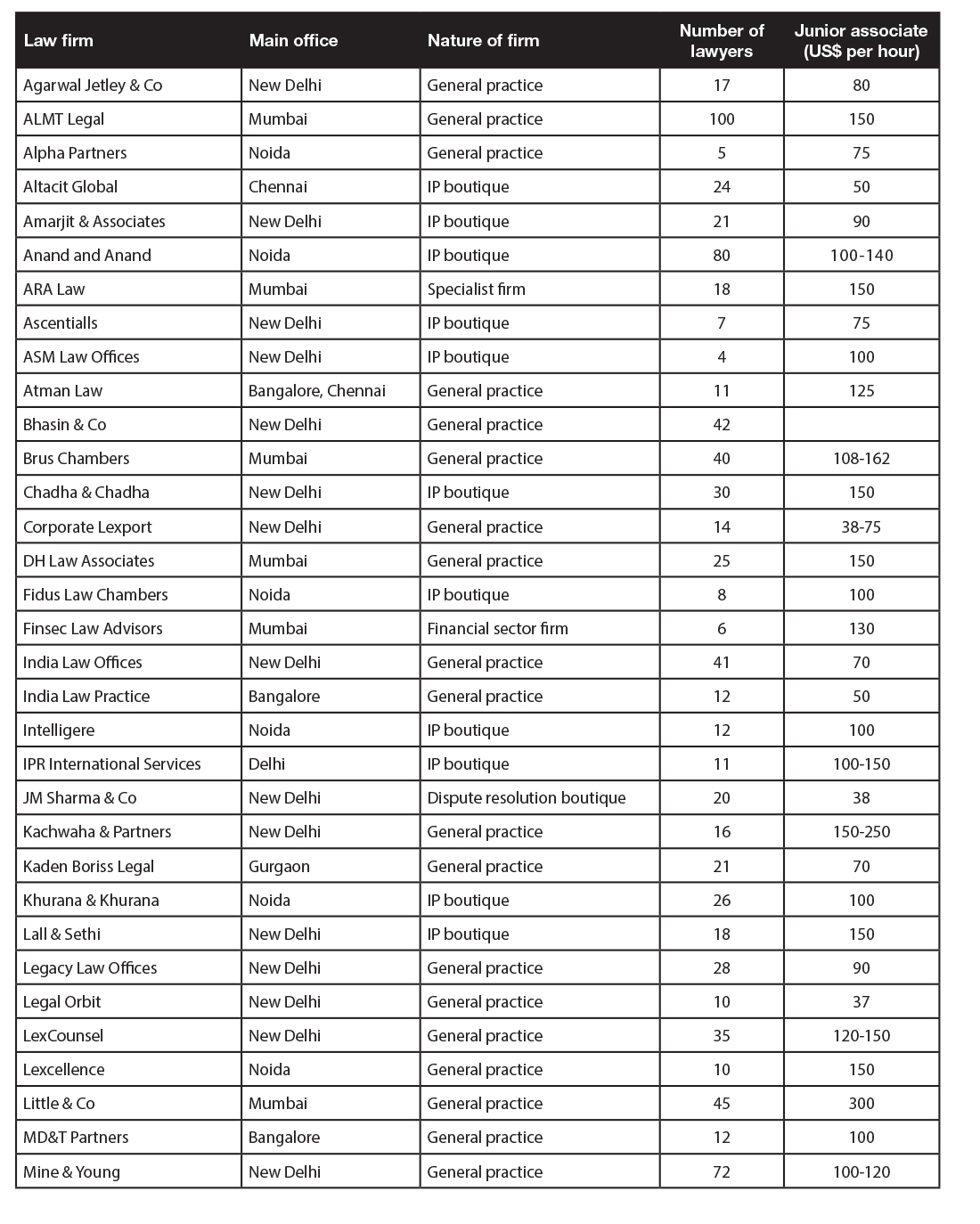
This year, a record number of participants came forward to publish their standard hourly billing rates. A total of 53 leading Indian law firms supplied India Business Law Journal with their legal fees by our press deadline, up from 44 participants last year. In 2007, when India Business Law Journal first asked law firms to go public with their hourly rates, 25 bold firms accepted the challenge. Five years later, the number of participants has more than doubled.
A total of 37 participants from last year shared their rates again this year. Of these, 62% (23 firms) increased their hourly billing fees, 35% (13 firms) retained last year’s rates, and one firm – Seth Dua & Associates – had a lower hourly rate overall. This suggests that rates could ascend again in 2013.
Firms which raised their legal fees did so by as little as 1% (SRGR Law Offices) and as much as 139% (Atman Law). IP boutique Khurana & Khurana, which recently opened offices in Pune and Hyderabad, pushed its prices up 103%. Tarun Khurana, a partner at the firm, says fees were enhanced “to be on par with tier 1-2 IP law firms”.

Amarjit & Associates retained 2011 rates for foreign clients, factoring in economic woes in the West. However, the firm is charging domestic clients 15% on top of these rates, reflecting optimism within the Indian legal market. Similarly, Bhasin & Co’s 40% fee rise was influenced by the perception of a healthy domestic economy. “Recession is no longer being faced … and things have improved considerably,” says Lalit Bhasin, the firm’s managing partner.
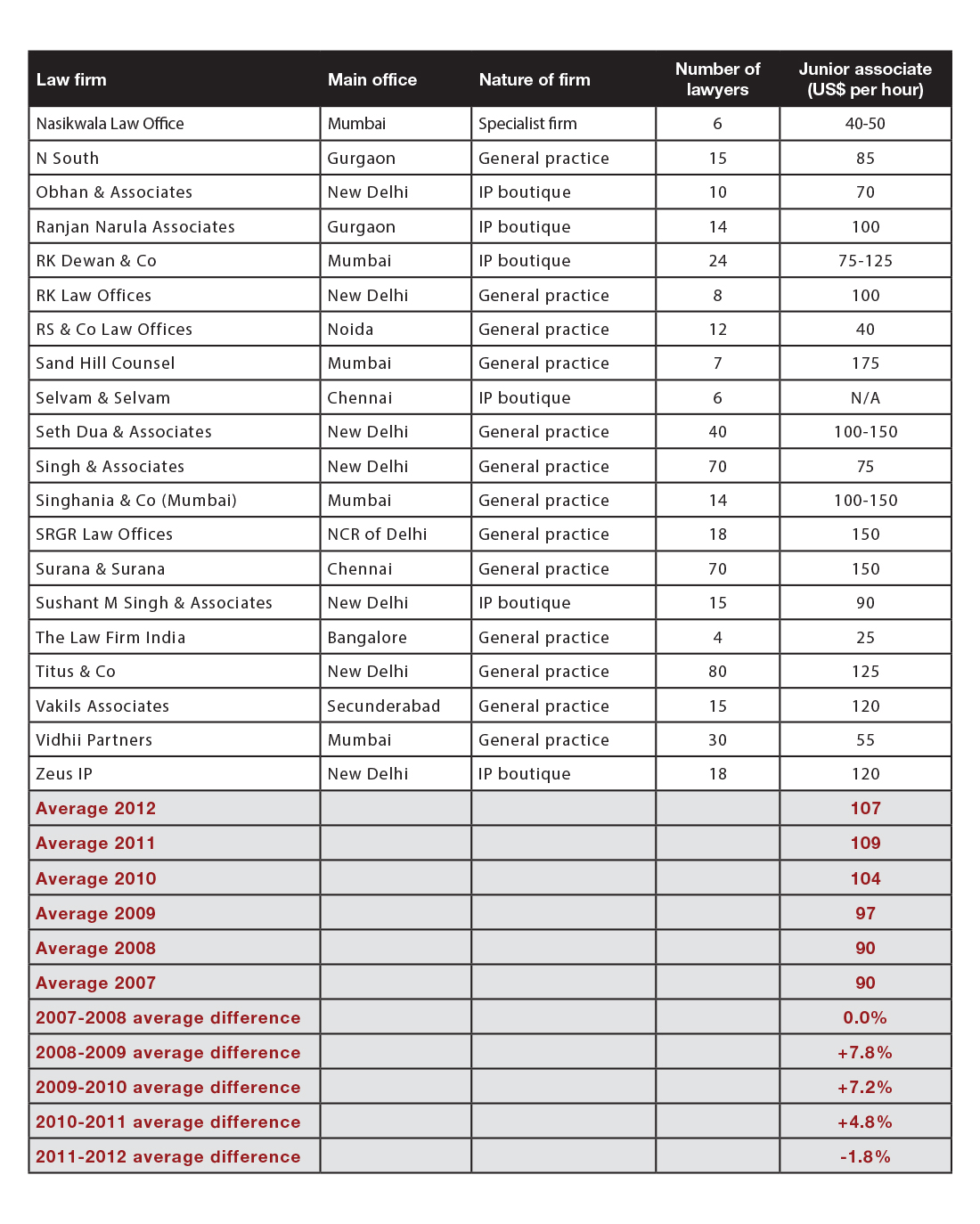
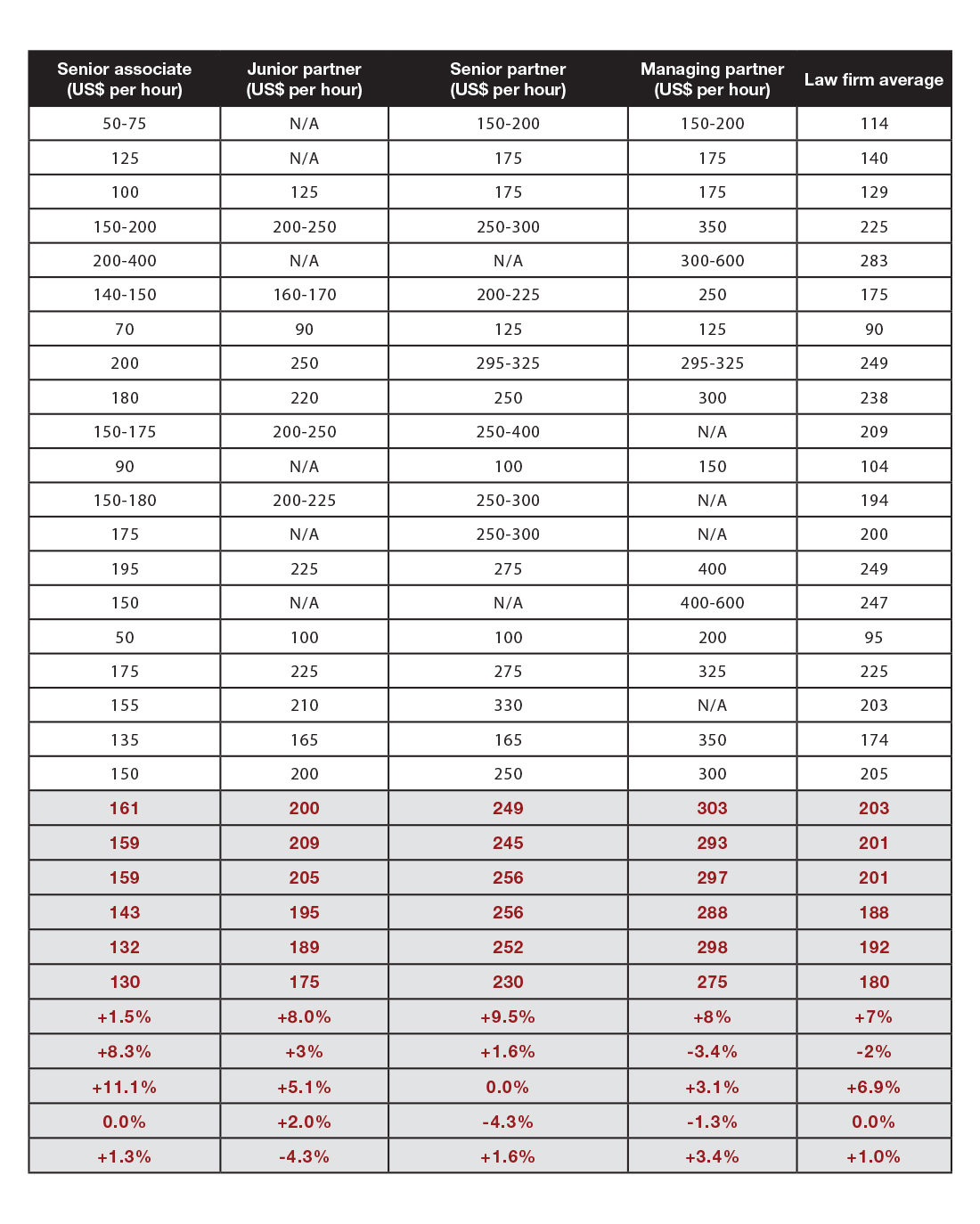
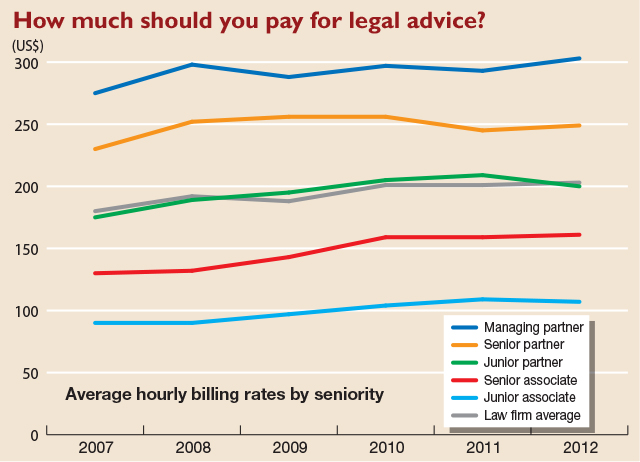
Based on the figures supplied by the firms in our survey, the average hourly billing rate at a law firm in India is US$203. This marks a 1% increase from 2011, a 12.8% rise compared with 2007, and the highest rate recorded by India Business Law Journal since its inaugural survey.
Some of this year’s results were surprising. The average hourly fees of junior associates and junior partners dipped for the first time since 2007.
The rate for a junior associate declined by 1.8% from 2011, to an average of US$107, while junior partner fees dropped by 4.3% to an average of US$200 per hour. By contrast, senior partner and managing partner rates climbed by 1.6% and 3.4%, respectively, to an average of US$249 and US$303. The average hourly fee for a managing partner is the highest since the survey began. However, the senior partner figure is 2.7% below the peak recorded in 2009 and 2010. The senior associate rate rose by 1.3% to an average of US$161 per hour.
Despite the dip in the junior associate rate, lawyers say that associates are earning more. “The compensation package of associates has trebled in the last three years,” says Srinivas Kotni, the managing partner at Corporate Lexport. “It is a trend that will likely continue and has to reflect in the billing for small law firms like ours to retain talent.”

Better alternatives
Corporate counsel still value and favour a broad spectrum of alternative billing methods. These include lump-sum and retainership arrangements, fixed or flat fees, and combinations of set fees plus additional hourly rates (blended rates).
Dave says that if he can estimate how long an assignment will take, he prefers a blended arrangement with a lump-sum fee based on a set number of hours and an hourly rate once this threshold is crossed. “Blended rates work well for us and we have been provided this option by several law firms including J Sagar Associates, DSK Legal, ALMT Legal and Naik Naik & Co,” he says.
Lump-sum billing is the norm for firms such as JM Sharma & Co – a dispute resolution boutique – which only uses hourly rates for 5% of its work.
Kotni, whose firm has been using the hourly billing model only for the past three years, is keen to apply it more rigorously. Kotni argues that hourly rates are “a more accurate reflection of time spent by an associate and useful in measuring their compensation”. However, he realizes that acceptance in India is a long way off as clients tend to perceive hourly rates “as likely to encourage inefficiency in service delivery”.
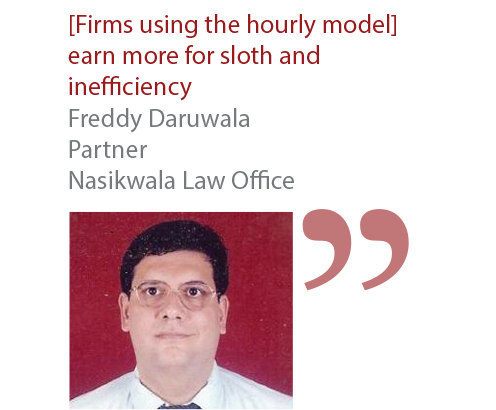
Freddy Daruwala, a partner at Nasikwala Law Office, agrees with such clients. His firm predominantly uses a fixed-fee model rather than hourly billing “to run a tight ship and also keep the client’s cost under control”. Daruwala says that firms using the hourly model “earn more for sloth and inefficiency, which translates into more time spent and higher billing”.
Another alternative fee arrangement is milestone-based billing, which India Law Offices uses for non-litigation work. For litigation, the firm charges a fee per hearing or per visit to the forum concerned. “In the case of an adjournment or a non-effective hearing, we reduce the fee significantly to ensure that the client does not lose out due to the vagaries of the legal system,” explains Gautam Khurana, the firm’s managing partner.
Money management
In-house lawyers and legal practitioners share smart tips to control your legal budget
Ensure that the assignments you give to a law firm are clear and precise. Also, do not proceed on presumptions and clarify any doubts as soon as possible to avoid multiple drafts
Rai Mittal, managing partner, RS & Co Law Offices
Be specific about what you want from your attorney. Vague instructions always lead to a mismatch in expectations and result in misunderstandings and disputes
Vinod Surana, partner, Surana & Surana
Seek cost estimates prior to issuing instructions and be upfront about the level of effort and seniority of the attorney that you want working on your mandate
Gurjot Singh, chief technologist,
Fidus Law Chambers
Ensure that meetings are scheduled with a predetermined agenda and query list, if feasible, for efficient time management. Collate internal comments and revert with a consolidated version to avoid duplication of work
PM Thimmaiah, owner, MD&T Partners
Don’t go to an external counsel without doing your homework and unless you have specific queries
Shobhna Bajaj, senior counsel,
Marriott International
Clients must do their own due diligence before they approach a lawyer or law firm. Focus on a lawyer’s accountability rather than their fee
Manish Desai, managing partner, Vidhii Partners
Engage lawyers at the very beginning, i.e. at the deal formation stage
Ravi Bishnoi, partner, SRGR Law Offices
Ensure proper documentation and timely filing to reduce legal expenses
Gunjan Paharia, managing partner, Zeus IP
Disputes are mainly because of faulty document drafting done in-house by companies thinking they are saving on legal fees. It is advisable to seek professional help to save money in the long run
Shrikant Hathi, partner, Brus Chambers
Go for long-term relationships with lawyers you work with; do not experiment with different lawyers
Praveen Agarwal, managing partner,
Agarwal Jetley & Co
Clients can do some of the initial preparation such as the synopsis, notes, introduction to the arrangement, working drafts, etc., to lower costs
Daizy Chawla, managing partner, Singh & Associates
Tell your lawyers who can travel business [class] and who needs to travel economy, which hotels they can stay at and a threshold beyond which they need to seek your prior approval. These things can get out of whack and then become non-negotiable
Rohit Dave, general counsel,
SRS Investment Advisors
Use firms which offer varied expertise under one roof, particularly in taxation. Term sheets and structure documents are often shuttlecocked by email between a law firm and a tax adviser, which results in delays, higher costs and lack of an integrated approach. This is generally the practice in India where most law firms do not offer tax advice
Freddy Daruwala, partner, Nasikwala Law Office
–
Lall & Sethi offers a fixed-fee schedule, which is mostly beneficial when filing trademark applications and includes costs up to registration. “Show cause hearings at the examination stage are usually more than one in number and under a normal schedule of costs, the charges for each of those hearings would be based on time spent and on the number appearances required,” says Tia Malik, a senior associate at Lall & Sethi. “Several follows-ups are required and we cover these under one amount, irrespective of the complexities, which proves cost-effective.”
Fidus Law Chambers offers a novel approach to legal fees, using tiers within a flat-fee structure depending on a client’s profile. “A startup, an individual client and a corporate client are all billed differently,” says Gurjot Singh, chief technologist at the firm. “Since the flat-fee model is also loosely based on an approximation of the time expected to be spent, we’re very transparent in telling a potential client that we’re slotting them in (a), (b) or (c) bracket and the relative level of seniority of the attorney that each bracket corresponds to. The client then has the option to scale up or down.”
Learning how to save
In-house lawyers say they would like law firms to provide greater assistance in managing legal spending. External lawyers may not see this as their role, although client servicing of this nature could reap big rewards, such as loyalty, in the long run.
Mittal at Lupin Pharmaceuticals says some law firms have suggested that Lupin develop “in-house skills for monotonous work,” and others have recommended standardizing documentation. However, Mittal says most have done little to help his team control and manage their legal budget.
“To be honest, this is one area where law firms across [the spectrum] are lacking,” says Dave. “I have to constantly monitor this.”
In-house lawyers often take matters into their own hands when it comes to monitoring spending. Mehta was once presented with a junior associate, a senior associate, a senior partner and a senior advocate on one matter. “When confronted as to why there was a need for so many lawyers, I ended up with one senior associate and one senior advocate,” he says.
Dave experienced a similar situation and says he “told the law firm politely ‘I don’t require four people – two will suffice’, and told them which two lawyers I wanted”.
Other in-house lawyers are less proactive. Raja Selvam, an attorney at IP boutique Selvam & Selvam, says costs can rise in complicated cases when clients rely primarily on their in-house counsel and fail to maintain proper records of their documents.
“When an acquisition or a merger takes place, or the corporate counsel changes, the risk is that the new counsel has no clue about existing documents or work pending with the outside counsel,” says Selvam. “In the bargain, clients end up making similar applications and could potentially lose their IP rights.”
For in-house counsel, building relationships with external lawyers is vital to ensuring efficiency, speed, accuracy and wise spending. Paying big bucks for reputation may be worthwhile in some cases, but only if a firm can guarantee the amount of partner interaction a client expects.
“A good in-house lawyer should find external counsel whose opinions they can trust,” says Shobhna Bajaj, senior counsel at Marriott International. “Once they find such an external counsel, they should stick with them. There is no point chasing big names unless you know the partner you want to work with and he or she has time for you.”
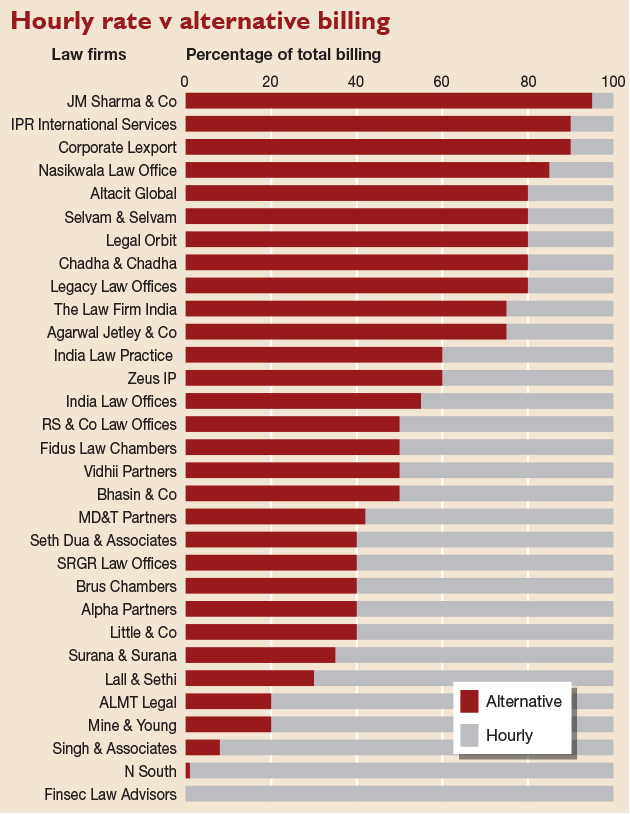
Smaller clients could profit from the flexibility offered by firms such as Alpha Partners, which recognizes the cost constraints that start-up entities and entrepreneurs face early on in their ventures. “We try to help startups by providing quality services at an affordable cost,” says Akshat Pande, a partner at the firm. “Our fee for startups is generally half of what we charge our established clients.”

More for your moolah
If there is one thing clients have mastered, it is the fine art of haggling. Indian companies are notoriously tight-fisted and will fight to pay bottom dollar regardless of the country’s economic buoyancy. But while negotiation is the hallmark of any client-law firm relationship, domestic businesses will not shy away from loosening their purse strings if value is promised.
“Where there is intellectual input and you’re able to build a relationship with the promoter group or guys close to them and they see value in the advice – not just making sure the document looks pretty and reads well, but value in terms of commercial input, different structures and how to overcome obstacles – that kind of relationship will fetch a much higher price,” says Anand Prasad, a senior partner at Trilegal.
Sodhi says she would happily fork out more money in return for “highly strategic, business-sensitive opinions without a caveat”. Maintaining high quality service, promptness and domain expertise are other big draws. “If you go to a particular firm you are also paying a premium attached to the quality of work product and reputation of the firm,” says Sodhi. “The work product needs to be consistent at all times.”

Dave says he would increase his legal budget for quick turnaround time and practical advice. “Quite often, law firms belabour the point and prolong the matter to end,” he says. “I like to work with people who understand the commercial side of deals and have a solutions-based approach rather than a stand-based approach.”
Bajaj echoes Dave’s concerns, lamenting that “most law firms like to spend hours – at your cost – extracting legislation that you already know, or should have known, and repeating clauses from contracts that you have drafted.” She adds that these lawyers offer “very little by way of advice, which given their caveats, could swing either way”.

Ideally, Dave would like to see law firms provide quality work, guarantee the availability of the partner responsible for the work, and deliver practical advice at reasonable rates. He is currently working with Jyoti Sagar, the managing partner at J Sagar Associates, on a private equity and real estate-related litigation. “We are trying to reach an out-of-court settlement with the other side,” explains Dave. “Jyoti has been leading the initiative for us. He meets all of the criteria above except the fee bit. Although I must admit, he does not charge as much as Zia [Mody at AZB & Partners] or Cyril [Shroff at Amarchand Mangaldas].”