





With corporate criminal liability cases, courts are faced with the responsibility of balancing accountability and fairness, writes Katherine Abraham
The subject of corporate criminal liability keeps finding its way, time and again, before the courts. The court had to once again render its decision on this matter in the case of Sanjay Dutt v State of Haryana.
The criminal liability of company directors in India has been a hot topic issue that has garnered significant media and legal attention, particularly in light of recent rulings by the Supreme Court.
The court’s recent decision in the above-mentioned case set the foundation and sharpened the contours of corporate criminal liability, specifically for company directors.
In the case, the Supreme Court division bench, comprising JB Pardiwala and R Mahadevan, clarified the extent of vicarious liability for company directors. The court observed: “While a company may be held liable for the wrongful acts of its employees, the liability of its directors is not automatic.”
It stated that a director may attract vicarious liability if: (1) the company was liable in the first place; and (2) if such director personally acted in a manner that directly connects their conduct to the company’s liability. Mere authorisation of an act at the company’s behest, or exercising a supervisory role within the company, was not enough to render a director vicariously liable.
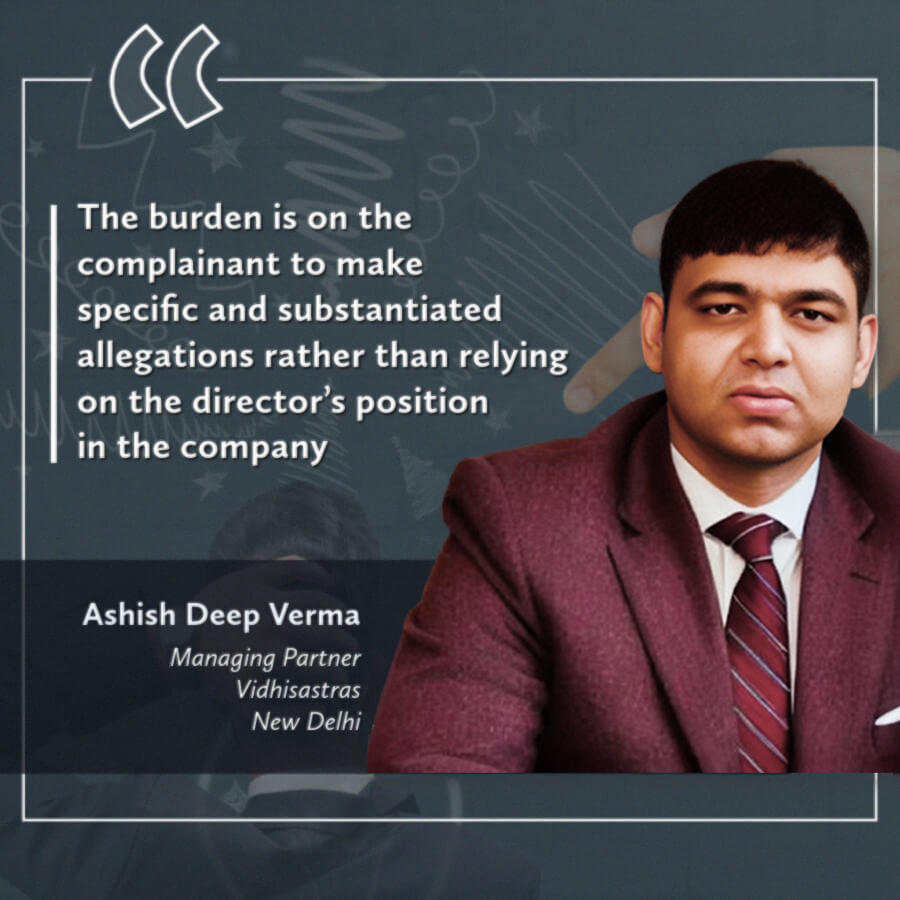 Ashish Deep Verma, managing partner of the litigation-focused firm, Vidhisastras, in New Delhi, says: “The burden is on the complainant to make specific and substantiated allegations rather than relying on the director’s position in the company.
“A crucial inference from this ruling is that courts must exercise caution in taking cognisance of complaints against directors.”
Guilty mind
In global legal history, companies were able to evade liability due to a lack of mens rea (guilty mind). The situation changed in 1915, with the UK case Lennard’s Carrying Co Ltd v Asiatic Petroleum, where Lord Haldane, one of five judges presiding over the case and influenced by German company law, identified the corporation’s “directing mind and will” as liable.
In the matter, Asiatic Petroleum contracted Lennard’s Carrying to transport oil, but the ship, the Edward Dawson, which was carrying the oil, sank due to its unseaworthiness. It was claimed that the managing director, Lennard, was aware of the ship’s defective condition and had failed to act.
The House of Lords, which at the time exercised judicial function, ruled that Lennard’s knowledge was attributable to the company because he was its “directing mind and will”. The court established the “identification doctrine”, or the “alter ego” theory, which holds that a company can be liable for the actions of individuals who represent its controlling mind. This landmark case redefined corporate liability law, clarifying when a company can be deemed responsible for wrongful acts committed by its key officers.
With the evolving corporate landscape, the question is whether the legal framework in India governing corporate leaders and their roles, responsibilities and potential accountability is enough.
Various Supreme Court judgments in India have aimed to clarify the extent to which directors can be held liable for criminal offences.
Verma says: “The [Dutt] judgment also signals a strong stance against frivolous prosecutions that fail to differentiate between corporate governance and criminal liability. By setting a clear threshold for imputing liability, the court ensures that only those who are directly involved in, or have actively facilitated, an offence are held accountable.”
Case origins
In Sanjay Dutt v State of Haryana, the appellants – Dutt, managing director and CEO of Tata Realty and Infrastructure; Tata Housing Development’s vice president, Kamal Sehgal; and former project head, Satpal Singh – were implicated in a complaint alleging the illegal uprooting of 256 trees and 62 small plants in Gurugram, Haryana.
The complaint, filed under section 4 of the Punjab Land Preservation Act, 1900 (PLPA), accused the appellants of causing environmental damage. The special environment court took cognisance of the complaint under section 19 of the PLPA.
The appellants sought to quash the proceedings, but the Punjab and Haryana High Court dismissed their petition, which led to an appeal before the Supreme Court. The Supreme Court, after a thorough examination of the complaint, especially in the absence of explicit statutory provisions imposing such liability, held that the PLPA did not contain any provisions that automatically imposed vicarious liability on directors or officers for offences committed by the company.
It further emphasised that, for a case of vicarious liability to be established, specific allegations relating to any personal involvement of the accused must be provided.
Speaking on the judgment, advocate Chinmay Bhosale, of the Bombay High Court, said: “India is facing a dangerous trend of making directors liable for actions of the company or its employees, since they are soft targets.” He added: “Stern action or imposing of heavy costs against such ill-found allegations is the need of the hour, in the absence of malicious prosecution laws in our country.”
The Supreme Court held that an authorisation or a supervisory role does not suffice for a charge of vicarious liability and there was no clear evidence of the parties being directly involved in the matter, apart from carrying out their routine corporate roles and duties.
Mitigating risks
“The Sanjay Dutt case provides valuable insight into the preventive measures that can be adopted to mitigate corporate liability risks,” notes Sara Sundaram, a partner in the white-collar crimes and dispute resolution practice at Cyril Amarchand Mangaldas (CAM) in Mumbai.
In examining constructive knowledge, a term used to define knowledge a person is legally presumed to have, the Supreme Court clarified that a director’s liability is not based on their title alone, but on whether they had awareness of and control over the company’s operations, even if they were not directly involved in the specific act.
Arman Roop Sharma, a partner at Anand Sharma & Associates specialising in white-collar crime and dispute resolution in Delhi, says: “Mere authorisation or supervision does not establish liability without evidence of direct involvement and intent.”
In the case of KK Ahuja v VK Vohra (2009), the court noted that the appellant filed two criminal complaints in Delhi against Motorol Speciality Oils and eight individuals under section 138 of the Negotiable Instruments Act, citing dishonour of cheques totalling INR41 million (USD478,000).
The company issued the cheques to the appellant’s firm. The appellant alleged that all the accused were responsible for the company’s financial dealings. On 3 October 2001, the magistrate ordered a summons to be issued to all the accused.
Speaking about the case, Tarun Gaur, an advocate with a focus on white-collar crime based in New Delhi, says: “The distinction between ‘direct involvement’ and ‘constructive knowledge’ was discussed where the Supreme Court examined the meaning of being ‘in charge of’ and ‘responsible for’ the company.
“The court ruled that only individuals who meet both criteria can be held liable under vicarious liability provisions.”
You must be a
subscribersubscribersubscribersubscriber
to read this content, please
subscribesubscribesubscribesubscribe
today.
For group subscribers, please click here to access.
Interested in group subscription? Please contact us.