






Judicial approach to determining gameplay copyright infringement

  • Law Asia
  • ABLJ
  • CBLJ
  • IBLJ
Register Login Subscribe
  • English
    • 中文 (Chinese (Simplified))
Resources
Awards galleryChina Business Law Directory - PRC law firmsChina Business Law Directory - Cross-border investment guide
Sections
NewsBusiness law digestDispute digestIn-house insightsPractitioners’ perspectivesCorrespondentsMarket watchLegal & regulatory insightsLexicon
Topics
New Company LawIntellectual propertyDispute resolutionCross-border investmentCapital marketsBankruptcy & reorganisation
Law.asia home
Archive
.TV
Awards
CBLJ Forum•Shanghai 2025
Events
Jobs
About us
Contact us
Follow Law.asia

China Business Law Journal
English English
  • 中文 中文
China Business Law Journal

    • SECTIONS

      • News
      • Business law digest
      • Dispute digest
      • In-house insights
      • Practitioners’ perspectives
      • Correspondents
      • Market watch
      • Legal & regulatory insights
      • Lexicon

      ABOUT US

      • Editorial board
      • Publisher & credits

      TOPICS

      • New Company Law
      • Intellectual property
      • Dispute resolution
      • Cross-border investment
      • Capital markets
      • Bankruptcy & reorganisation

      RESOURCES

      • Awards gallery
      • China Business Law Directory - PRC law firms
      • China Business Law Directory - Cross-border investment guide

      E-READER EDITION

      ARCHIVE
China Business Law Journal China Business Law Journal
  • Sections
    • News
    • Business law digest
    • Dispute digest
    • In-house insights
    • Practitioners’ perspectives
    • Correspondents
    • Market watch
    • Legal & regulatory insights
    • Lexicon
  • Topics
    • New Company Law
    • Intellectual property
    • Dispute resolution
    • Cross-border investment
    • Capital markets
    • Bankruptcy & reorganisation
  • Videos
  • Awards
  • Jobs
  • Subscribe
  • Events
    • CBLJ Forum • Shanghai 2025: Registration
    • CBLJ Forum • Beijing 2025: Report
    • Other events
  • Law Asia
  • ABLJ
  • CBLJ
  • IBLJ
  • icon
    • Login
    • Register
  • Law Asia
  • ABLJ
  • CBLJ
  • IBLJ

China Business Law Journal
  • Sections
    • News
    • Business law digest
    • Dispute digest
    • In-house insights
    • Practitioners’ perspectives
    • Correspondents
    • Market watch
    • Legal & regulatory insights
    • Lexicon
  • Topics
    • New Company Law
    • Intellectual property
    • Dispute resolution
    • Cross-border investment
    • Capital markets
    • Bankruptcy & reorganisation
  • Videos
  • Awards
  • Jobs
  • Subscribe
  • Events
    • CBLJ Forum • Shanghai 2025: Registration
    • CBLJ Forum • Beijing 2025: Report
    • Other events
English English
  • 中文 中文
  • icon
    • Login
    • Register
Home Wang Jing & GH Law Firm Judicial approach to determining gameplay copyright infringement
  • Wang Jing & GH Law Firm

Judicial approach to determining gameplay copyright infringement

By Jeff Yang, Wang Jing & GH Law Firm
8 May 2024
0
635

There have been many cases of copyright infringement regarding gameplay in recent years, with some infringers even ordered to pay RMB50 million (USD6.9 million) in damages, the highest amount awarded to date in game-related infringement disputes. Behind the huge compensation, how does the court decide whether the gameplay constitutes a copyright infringement? Based on judicial cases available at present, this article outlines the following judicial approaches to determining copyright infringement in gameplay.

Types of work involved

In judicial practice, there are usually two modes of copyright protection for gameplay. One is to provide overall protection for the game at issue, and the other is to provide separate protection for particular elements of the game, such as textual descriptions and artistic images, categorised as literary and artistic works, respectively. With the accumulation of judicial experience, there is little dispute that online games can be protected as a whole. However, the types of work they constitute have changed due to the revision of the Copyright Law in 2020.

Before the Copyright Law was amended, plaintiffs and courts mostly protected the gameplay by arguing that the overall game visuals constituted cinematographic works. After the Copyright Law was amended to add “other intellectual achievements” to the types of works, the courts have gradually developed new ideas about whether the gameplay – such as game structure, systems, numerical planning and corresponding relations – could be included in the protection of audiovisual works (formerly categorised as cinematographic works). The protection of gameplay as “other intellectual achievements” may become a prevailing trend in judicial practice going forward.

Infringement scope of comparison

Jeff Yang, Wang Jing & GH Law Firm
Jeff Yang
Director
Wang Jing & GH Law Firm

The first step in assessing potential infringement is to determine the scope of comparison. According to the idea-expression dichotomy, the Copyright Law does not protect abstract ideas, concepts or systems. Therefore, ideas should be removed from the scope of comparison first.

For example, in a strategy and simulation game, the players fulfil the main mission through a series of decisions and battles within a specific time and space. To this end, the game should provide a basic design of rules such as lands, resources and seasonal missions. These basic rules fall in the scope of ideas, which are not protected by the Copyright Law.

Apart from ideas, the historical facts, literary works and other contents in the public domain – as well as expressions that are not created for literary, scientific or artistic purposes such as game operation rules for novice protection, recharge packages, seasonal awards and the like, which are only for commercial purposes – should be excluded from the scope of comparison, because they are not “works” defined in the Copyright Law.

Determining substantial similarity

Once the scope of comparison is established, the court employs various methods to compare the two games, including:

Identifying any substantial similarity by comparing individual elements. The comparison involves scrutinising individual elements such as artistic images, game maps, character skills, weapons, equipment and non-player characters (NPCs). Each element’s specific functions or design are evaluated to determine if there is a one-to-one correspondence in the specific way of presenting an element, indicating substantial similarity.

Whether the interrelation and coupling between elements/rules constitute a substantial similarity. Substantial similarity is not determined by comparing individual elements. The court will also consider the interrelation and coupling between elements/rules within the overall game structure to ascertain if there is substantial similarity in the selection, arrangement, combination and interaction of different elements and rules.

Whether the allegedly infringing game retains the core/distinctive features of the copyrighted game. The court will focus on whether the core/distinctive features of both games are similar. The core/distinctive features of gameplay can generally be determined based on the game theme, player experience, comparison of prior games, etc.

In Minecraft v Netcraft, for example, the core mission and features system of Minecraft emphasises players’ freedom to create and destroy blocks, and progress in the game, while Netcraft focuses on social networking. Since the design of mission and feature systems differs significantly between the two games, the court ruled in favour of no plagiarism.

Whether the allegedly infringing game copies the unique mark or errors of the copyrighted game. The use of distinctive identifiers or errors from the copyrighted game in the accused game can serve as initial evidence of substantial similarity. For example, in Rise of Kingdoms v Commander, the misuse of punctuation marks and randomly set amount of recharge awards in the plaintiff’s game were entirely adopted by the defendant’s game, leading the court to deem this replication as clearly exceeding reasonable bounds.

Whether the overall presentation of the game gives the players a sense of consistency. The purpose of expression is to engage the audience, and analysing the similarity of gameplay should be closely tied to the player’s gaming experience.

Therefore, the court will usually also evaluate the two games in dispute based on the following player perceptions: whether existing player reviews suggest a similarity between the two games; whether the players opine that the two games are highly similar from the overall interface effect; whether the differences between the games fundamentally impact player experience; whether the content in question is an essential step or process in players’ experience of a particular gameplay.

With reference to the above-mentioned dimensions, when determining whether the gameplay of two games constitutes similarity, incorporating the perspective of players for first-hand experience can be beneficial. If the experiential feedback shows a high level of consistency, it may increase the likelihood of substantial similarity.

Jeff Yang is a director at Wang Jing & GH Law Firm

Wang Jing & GH Law Firm14, 17/F, Central Tower
5 Xiancun Road, Zhujiang New Town
Tianhe District, Guangzhou 510623, China
Tel: +86 20 3564 1888
Fax: +86 20 3564 1899
E-mail: yj@wjngh.cn
www.wjngh.cn


  • TAGS
  • Copyright Infringement
  • Experiential Feedback
  • Gameplay
  • Gaming
  • INTA2024
  • Jeff Yang
  • Judicial Approach
  • Online gaming
  • Player Perception
  • Scope of Comparison
  • Substantial Similarity
  • Types of Work
  • Wang Jing & GH Law Firm
Previous articleImpact of new Criminal Law on private enterprise compliance
Next articleGetting to the regulatory heart of medical parallel imports
Jan

RELATED ARTICLESMORE FROM AUTHOR

India Online Gaming Bill 2025
Business Law Digest

India’s new Online Gaming Bill set to change the game

AI Copyright Challenge
Anand and Anand

Beyond the black box: Rethinking copyright in the age of AI training

By Pravin Anand, Siddhant Chamola, Alvin Antony and Ajai K Garg, Anand and Anand
Online Gaming Under PMLA
Phoenix Legal

Online gaming not all fun and games

By Aman Avinav, Phoenix Legal

MOST POPULAR

China Business Law Awards (Regional Awards) 2025

13 October 2025
China Business Law Awards 2025 New

China Business Law Awards 2025

Which Chinese and international law firms have earned client trust through exceptional expertise?

23 July 2025
In-house-Counsel-Awards-2025 New

In-house Counsel Awards 2025

“In-house Counsel Awards 2025” recognise top legal leaders and teams

18 June 2025
Which Chinese and international law firms have earned client trust through exceptional expertise?
“In-house Counsel Awards 2025” recognise top legal leaders and teams

CORRESPONDENTS

Overview of legal framework for Ecuador’s mining sector

By Cheng Jun and Zhao Zeyu, Zhong Lun Law Firm
10 November 2025
Sierra Leone’s mining legislation overview

Overview of Sierra Leone’s mining legislation

By Cheng Jun and Li Ji, Zhong Lun Law Firm
14 October 2025

Disproportionate capital reduction under the new Company Law

By Zuo Yuru and Yang Yue, Zhong Lun Law Firm
13 October 2025

FEATURES

Research, recalibrate, repeat

Market shakeups lead to increasingly complex dispute issues and novel investor strategies to resolve them

16 October 2025
Key issues in confidentiality agreements

Guard your secrets

Nuctech’s legal director decodes confidentiality agreements

15 October 2025
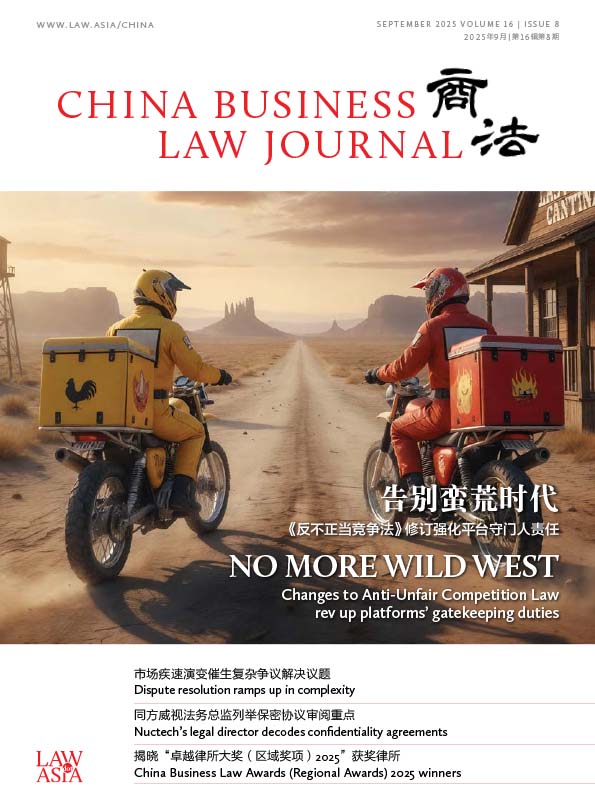
Anti-Unfair Competition Law rev up platform duties

No more wild west

Revised Anti-Unfair Competition Law steps up platforms' gatekeeping duties

14 October 2025
Dispute resolution ramps up in complexity
Nuctech’s legal director decodes confidentiality agreements
Revised Anti-Unfair Competition Law steps up platforms' gatekeeping duties

PRACTITIONERS' PERSPECTIVES

Cross-border debt recovery: Lessons from a guarantee dispute

By Armstrong Chen and Wang Xin, Dacheng Law Offices
11 November 2025
Nominated Subcontractor Risks Real Estate

Countering RE dilemma of ‘nominated subcontractors’

By Tony Wang and Hussein Hu, Wintell

This article systematically analyses prevailing judicial trends and compliance essentials, offering practical strategies for risk isolation and contract management

15 October 2025
Criminal Risk Prevention for Enterprisesvideo

Guide to criminal risk for enterprises

By Xia Yu, Kangda
15 October 2025

Lexicon

Institutional law reform

Skills training for corporate counsel

10 November 2025
LAW.ASIA

Asia’s leader in legal intelligence

Law.asia is an award-winning portal providing news, analysis and expert advice on business law in Asia to in-house counsel, lawyers in private practice and other business and legal leaders. It features the proprietary editorial content and archives of our premium legal magazines – Asia Business Law Journal, China Business Law Journal and India Business Law Journal – along with videos, law firm listings, awards and much more. Produced by Law.asia Limited, an independent media company, Law.asia is multilingual, offering content in English, Chinese, Japanese and Korean. Find out more.
Follow Law.asia
Law firms Awards Events Legal jobs • Post a job
About us Archive Subscribe Contact us
Please send any press releases, deal announcements, details of new hires, newsletters and any other news items to: news@law.asia
  • Policy on advertising & sponsorship
  • Disclaimer
  • Terms & conditions of use
  • Privacy Policy
© Copyright 2026 Law.asia Limited. All rights reserved.
Imagined by DOOD Website Design

Follow us on LinkedIn

Follow now