



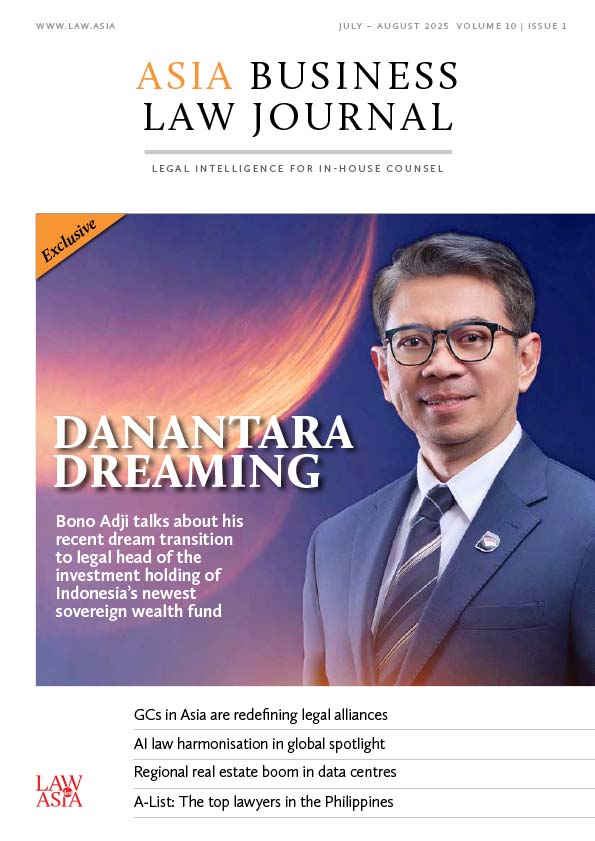


Asia Business Law Journal – March/April 2020
Volume 4, Issue 5
Subscribers can sign in to access the following PDF.
You must be a
subscribersubscribersubscribersubscriber
to read this content, please
subscribesubscribesubscribesubscribe
today.
For group subscribers, please click here to access.
Interested in group subscription? Please contact us.
你需要登录去解锁本文内容。欢迎注册账号。如果想阅读月刊所有文章,欢迎成为我们的订阅会员成为我们的订阅会员。
Highlights:
Lines are drawn
Fighting enemies new and old
The COVID-19 pandemic has brought war analogies to our living rooms and the whole world is now a “battlefront” with governments taking decisions on a “war footing”; and civilians going about their duties are our “brave heroes” on the “front lines” of this fight.
The rhetoric has co-opted us all as willing soldiers in this protracted struggle to save lives, secure our livelihoods, steady our businesses, revive our economies and bring back normalcy. However, the post-pandemic world will be decidedly different, a “new normal” that offers fresh opportunities and unheard-of challenges.
In our Cover Story, we try to make sense of the policy changes by various governments in the Asia-Pacific region, and explain what they mean for businesses, especially ones that operate across markets. Unprecedented policies coupled with the peculiar nature of the crisis make the way forward a tightrope walk for governments in both developed and developing economies.
Given the novel nature of the crisis, policymakers have resorted to a variety of fiscal and policy measures and, without the luxury of being able to resort to a tried and tested emergency playbook, a lot of the measures taken have been unorthodox, with long-term impacts difficult to predict.
In Home and safe? Jim Fitzsimmons, a cybersecurity expert at Control Risks, helps us understand the risks posed to business as companies are forced to implement work-from-home policies. Many companies have quickly adopted cloud-based productivity tools to support a suddenly remote workforce. In the rush to adapt, however, companies have become increasingly concerned about the overall cybersecurity of this approach to working.
For many years, cybersecurity was based on a perimeter security model: Protecting an organization’s information and computers was predicated on isolating them from external access. Computers could connect to the internet on the “outside”, but, in principle, no connections from the outside were let in. But when everyone is working from home, they are all on the “outside”, and this old security model is poorly suited to a mobile workforce.
Even as modes of working and the nature of offices evolve and adapt to a new order, there are a few things that refuse to change – the patriarchal structures that underpin our societies and businesses is one. In Power & parity, we chronicle the unfortunate commonalities and universals still hindering the progression of women lawyers in Asia and around the world. The business community in Asia is still predominantly male-driven, and discrimination against women is common.
“What’s been the real challenge is the unspoken expectations,” says Stefanie Yuen Thio, joint managing partner at TSMP Law in Singapore.
“You have to be every inch a professional, and very much a lady. Stand up to your male counterpart, but don’t lose your femininity. You must be able to carry as many documents as they can, and walk as fast; but you must do it in 3-inch heels and a smart pencil-skirt suit because that’s how women project professional credibility.”
However, women are disrupting these patriarchal structures and claiming their rightful place, from Australia to Pakistan. We talk to 14 women leaders in the region’s legal industry who are becoming role models and improving the prospects for younger women lawyers.
In our Head 2 Head series, we bring to you a detailed look at two hot and emerging areas of jurisprudence in the region – cybersecurity laws and cryptocurrency regulations. In the cybersecurity series, we give you a comparison of regulations in China, India, Indonesia and Taiwan, while the cryptocurrency series explains the latest developments on the topic in India, South Korea and Thailand.
This issue also brings to you the Indonesia A-list, with profiles of the country’s top 100 lawyers. And finally, we also offer a directory of law firms in the Philippines.
Best wishes,
Mithun Varkey
Editor, Asia Business Law Journal
Managing Editor, Vantage Asia
In this issue




Cybersecurity
Data protection and cybersecurity are evolving areas of regulation in Asia. Here, experts shed light on emerging jurisprudence in the region’s top jurisdictions


ACC develops COVID-19 resource hub
The Association of Corporate Counsel (ACC) has developed a range of resources to assist the global in-house community in guiding their organizations through the crisis

A contemporary IP regime
A lot of changes are underway to strengthen the intellectual property (IP) system in India. This article captures a snapshot of several initiatives made in this direction


For better or worse: The legal limits of comparative ads
Millions are spent every year by companies on comparative advertising, and many times these advertisements are taken down due to claims of disparagement.

Levelling the field
The career growth of a female lawyer is often challenged by difficult work-life balance choices, leadership bias, a lack of opportunity for dialogue and debate, and stagnant workplace cultures

Power & parity
Senior women lawyers across Asia share personal stories of successes and struggles for a more inclusive legal profession


Cryptocurrencies
Governments across the region are being forced to clear the regulatory air on virtual currencies as they can no longer afford to ignore their popularity


The A-List 2020: Indonesia
Asia Business Law Journal reveals the top 100 lawyers practising in Indonesia

Pandemics, police power and private contracts
Under the Bayanihan Act, the president is empowered to order private establishments to direct their operations towards COVID-19 efforts.

KICA launches English homepage
The Korea In-house Counsel Association (KICA) has launched an English-language website designed to meet the interests of foreign institutions, law firms and Korea’s foreign in-house community

Home & safe?
With COVID-19 forcing companies to implement work-from-home policies, Jim Fitzsimmons helps us understand the cybersecurity risks posed by a remote workforce

First in line
A detailed analysis of Taiwan’s intellectual property regime: Trademark protection is obtained through registration and Taiwan follows the first-to-file system