




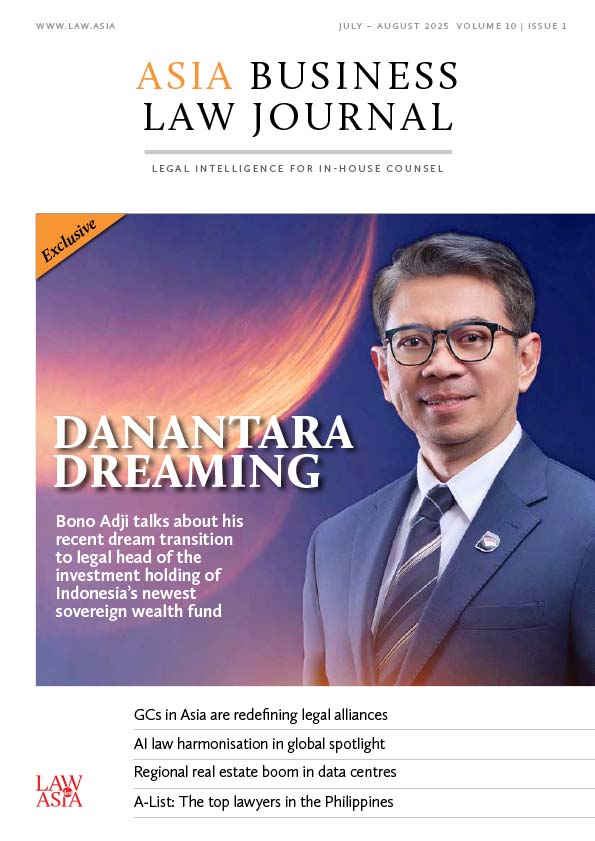


Asia Business Law Journal – May/June 2021
Volume 5, Issue 6
Subscribers can sign in to access the following PDF.
You must be a
subscribersubscribersubscribersubscriber
to read this content, please
subscribesubscribesubscribesubscribe
today.
For group subscribers, please click here to access.
Interested in group subscription? Please contact us.
你需要登录去解锁本文内容。欢迎注册账号。如果想阅读月刊所有文章,欢迎成为我们的订阅会员成为我们的订阅会员。
Highlights:
Shifting gears
Law firms reluctantly ride the digital highway
One of the unexpected (and surprisingly positive) outcomes of the pandemic was its acceleration of technology adoption. Nearly every country and most businesses responded to the health crisis and associated lockdowns by deploying technology, often with tools that have been around for a while but were never deemed quite necessary.
From tracking and tracing people to video-conferencing court proceedings, to vaccinating large portions of the world’s population, we have found ways to repurpose existing technology to meet new demands and solve unprecedented problems.
The legal industry has long been identified as a technology laggard, but the pandemic left little choice for legal practitioners but to accept an upgrade, even if grudgingly.
The need for collaboration in times of social distancing also forced even the courts, those bastions of traditionalism, to allow themselves some tech disruption, which meant lawyers had to follow.
The importance of conventions and the nature of the profession means lawyers are trained to stand by the status quo. Their business models have remained unchanged, where clients are charged for billable hours, clocked in six-minute increments, with few incentives to bring in efficiencies.
Whether by push or by pull, there is no doubt that law firms are now seeing the value in implementing technology.
Our Cover story, Lawyering 2.0, enlists some of the biggest legal technology firms to chronicle the impact of the pandemic on tech adoption and how it is changing the legal process. The article is the first in a two-part series and discusses the drivers for legal technology and the opportunities and challenges that law firms face when buying technology tools. It also offers practical advice on ensuring the safety of sensitive documents and data.
In Singapore’s secret recipe, we interview the CEO of the Singapore International Arbitration Centre (SIAC), Lim Seok Hui, about her strategies, emerging trends in arbitration, and the recipe for the centre’s success. The SIAC was named the most preferred arbitral institution in the Asia-Pacific and ranked second in the world, according to the 2021 International Arbitration Survey by Queen Mary University of London and White & Case, which also ranked Singapore and London as the most preferred places for international arbitration. The SIAC’s success isn’t incidental – it has been the result of strong leadership, careful guidance and constant evolution.
Lim confides that the recipe to the SIAC’s success is built on three pillars – a highly international arbitration ecosystem; regularly updated rules that are innovative and offer users a range of time and cost-saving mechanisms; and the stature, wealth of experience and specialist knowledge of its board and court members.
Following the stellar success of our Japan outbound investment guide, we are proud to bring you the Korea Outbound Investment Guide. This is a collaborative supplement, in association with the Korea In-house Counsel Association (KICA), which has insights from expert lawyers in some of the most exciting economies around the Asia-Pacific and Africa, including Taiwan, Vietnam, Thailand, the Philippines, India and Nigeria. The guide provides practical advice to Korean in-house counsel and senior management on managing their investments in these jurisdictions.
Staying on expert advice, in Spinning your Zoom we give you handy tips to make your webinars livelier and more engaging.
Were the eyes of your colleagues glazing over at your last Zoom meeting? Do webinar audiences nod off before you’ve completed a sentence? Communications expert John Miers discusses how to retain your virtual audience and build eye contact with them.
Safeguarding trademarks presents real challenges amid the current pandemic, with massive shifts to online trading, difficulties getting cases to court and physical enforcement challenges, to name a few. As policymakers and regulators rush to adapt, many Asian jurisdictions have rejuvenated their regimes to protect valuable IP and the public interest.
In our Head to Head section, we bring top trademark lawyers from India, Japan, Taiwan and the Philippines to discuss the latest in IP law in their respective jurisdictions.
This issue also features our Japan A-List, a guide to our top 100 lawyers in the country.
Best wishes,
Mithun Varkey
Editor, Asia Business Law Journal
Managing Editor, Law.asia
In this issue






The yes, no, maybe of 2021 intermediary rules
There has been an ongoing debate on the yays and nays of the 2021 intermediary rules, primarily because India is set to begin enforcing a new set of rules that fundamentally changes the way the internet will be experienced in the country

Japan A-List 2021
Following an extensive nomination process, Asia Business Law Journal reveals the A-List of the country’s legal profession





Foreign liquidator assistance and common law in Bermuda
Foreign liquidators may apply for recognition in Bermuda pursuant to the common law by the application of the principles of comity


Singapore’s secret recipe
SIAC's CEO talks about strategies for the centre's success and emerging trends in arbitration

Spinning your Zoom
Communications expert John Miers offers some practical advice for engaging and retaining your virtual audience


Liability of guarantors after landmark India verdict
Guarantors, whether personal or corporate, have an intrinsic relationship with the corporate debtor in their capacities as directors, promoters, associates, subsidiaries or holding companies.