









A sweeping legal overhaul is forcing China’s internet giants to play by new competition rules, rebalancing power between platforms, merchants and consumers. Luna Jin reports
It is late evening in a small restaurant tucked in with others along Beijing’s Third Ring Road. Delivery riders rush in and out, the kitchen never stops. Business appears to be booming, but the owner sighs: “The platform’s subsidy slashed our prices, and we’re the ones footing the bill.”
The lament is not an isolated one. Across China, small businesses are caught in a paradox: platforms bring them visibility, but at the cost of unsustainable discounts, opaque rules, and algorithmic pressure on their bottom line.
The pressure intensified in April 2025, when the three food-delivery behemoths – Meituan, JD.com and Alibaba’s Ele.me – unleashed a wave of subsidies, each offering billions of renminbi in coupons to lure customers and grab market share. Merchants were caught in the middle. Joining the subsidy wars might boost visibility, but it also guaranteed thinner margins, and opting out risked being drowned out in the digital marketplace.
In a tech-driven economy, platforms have long acted as both referee and player, setting the rules of engagement while dominating the game. Smaller businesses were left with little bargaining power: to be seen, they had to be prepared to lose money.
Now, that game is changing. This longstanding imbalance stands as the target of a profound regulatory correction.
In early 2025, China rolled out a major revision to its Anti-Unfair Competition Law (AUCL), marking a decisive shift in how the country governs its digital economy. The new law does not just fix gaps – it redraws boundaries, imposes real responsibilities on platforms, and aims to restore fairness in a market long tilted towards the giants.
In June 2025, China passed a comprehensive revision of its AUCL, set to take effect on 15 October. It strengthens fair market competition by defining the responsibilities of online platforms for the first time, closing legal gaps in the digital realm and mandating a new era of what officials term “fair competition”.
“The old law was often too general, with vague criteria for identifying violations,” says Zhan Hao, managing partner of the Beijing office of AnJie Broad Law Firm. “By categorising new types of unfair conduct based on established regulatory experience, the revision makes enforcement more efficient and gives companies clearer compliance expectations.”
Full-on obligation upgrade
The most significant shift lies in the expanded duties imposed on platform operators. They are no longer treated as neutral intermediaries but are now cast as “gatekeepers”, legally responsible for maintaining a level playing field among the businesses that depend on them.

“Platform operators are no longer just market competitors; they are also managers of their own ecosystems,” explains Liu Cheng, a partner at King & Wood Mallesons in Beijing. “They now have a positive duty to review and supervise the conduct of the merchants on their sites.”
A headline change is an explicit ban on platforms forcing or strong-arming merchants into selling below cost. Such practices, often disguised as “marketing campaigns” or driven by opaque “algorithmic recommendations”, have long been a source of tension.
Yang Jianhui, a partner at Jingtian & Gongcheng in Beijing, says that platforms must now adapt their rules to ensure healthy competition. “Large platforms can no longer use their relative advantage to squeeze the small and medium-sized enterprises that rely on them,” he says.

The effectiveness of this ban, however, hinges on enforcement. Ye Han, a partner at Merits & Tree Law Offices in Beijing, identifies two key challenges: precisely defining what constitutes “forcing or strong-arming”, whether overt or hidden in algorithmic settings, traffic allocation or incentive structures; and setting a workable standard for determining “below-cost” pricing.
The revised law also tackles the “abuse of relative advantage”. Previously, only companies with full-blown “market dominance” could fall foul of competition rules. Now, an imbalance of power in a specific trade relationship, such as a platform’s control over a vital sales channel or a merchant’s technological dependency, can trigger scrutiny of contractual fairness.
Zhan believes the new law aligns China with a global trend of stricter digital regulation while addressing local issues such as platforms blocking each other’s links, or maliciously making their services incompatible.
In recent years, these tactics, along with forcing merchants into “pick one of two” exclusivity arrangements, became commonplace, eroding the foundations of market competition and stifling innovation.
Liu notes a crucial distinction from antitrust law: “The new AUCL law focuses on an imbalance of bargaining power within a specific transaction, not control over an entire market.” The concept of an “advantageous position” in the new law is therefore more flexible and context-dependent than the traditional definition of “market dominance” under the Anti-Monopoly Law.
He sounds a note of caution, pointing out that Chinese courts have yet to establish detailed tests for identifying such an advantage. Some past rulings have even viewed a refusal to deal based on a strong bargaining position as a legitimate exercise of commercial autonomy, not necessarily an unfair competitive practice.
In response, Zhan advises platforms to build robust compliance around four pillars.
-
- Data governance. Implement a classified and tiered data management system, moving beyond merely having a data policy to establishing actionable and auditable mechanisms for refined management;
- A thorough review of platform rules. Given that rules governing merchant entry, ranking algorithms, and incentive structures are fertile ground for abuse of a “relative advantage”, platforms should consider pre-emptive compliance reviews, enhance transparency and notification, and set up internal channels for appeal and mediation;
- Algorithm auditing. As algorithms have become tools for unfair practices such as self-preferencing and hidden discrimination, platforms must consciously retain evidence demonstrating the “good faith” and “reasonableness” of their algorithmic logic; and
- A culture of compliance. Compliance should extend beyond the legal department and reach the front lines of business through training programmes.
Liu adds that platform operators have a duty to either proactively monitor or reactively identify unfair competition on their platforms, and to take necessary punitive actions promptly such as “delisting products or services, restricting traffic, or suspending or terminating service”.
He also notes that “when platform operators take action against unfair competitive practices by merchants on their platform, they are obliged to maintain records and report to the market regulatory authorities in accordance with regulations, thereby providing a basis for subsequent oversight and law enforcement”.
Penalties for failure are now severe. Fines can reach five times illegal gains or RMB5 million (USD690,000), whichever is higher. Legal representatives and managers face personal fines of up to RMB1 million. Serious violations can lead to suspended operations or the revocation of business licences.
“The stakes have been raised dramatically,” warns Zhan. “Corporate liability has become personal liability, and operational risks have become existential risks.”
Beyond the ‘big stick’
China’s approach to taming its tech giants has evolved. The period around 2021 was defined by a “big stick” approach, featuring record fines for anti-competitive behaviour, such as the RMB18.2 billion penalty handed to Alibaba. The message was clear: the era of lax oversight was over.
Since 2023, however, as the sector’s growth has moderated, regulatory tactics have shifted. The goal of maintaining fair competition remains, but the methods have diversified. Regulators now more frequently use admonishment talks, guidance and warnings to prompt companies to self-correct, seeking a balance between curbing excess and fostering innovation.
This shift was evident earlier this year, when the State Administration for Market Regulation (SAMR) held talks with major delivery platforms over their subsidy wars. The companies quickly pledged to comply with the law, reject “vicious subsidies”, and promote “orderly development”.
The “admonishment talk,” a form of flexible supervision now codified in the new law, contrasts with the immediate punitive investigations of the past. It allows regulators to summon company executives to explain themselves and propose remedies.

“These tools are both flexible and efficient,” says Ye. “They allow the authorities to understand a case fully before launching a formal, resource-intensive investigation.”
Flexible enforcement does not mean leniency. Rather, it emphasises pre-emptive intervention and process management. Liu sees this as creating a valuable “compliance buffer” for businesses.
Ye adds that if companies can satisfactorily explain their actions and implement real changes during the talks, they can avoid formal proceedings, penalties and reputational damage. “It creates an incentive for self-assessment and correction of these platforms,” he says, giving examples such as prioritising payments to small businesses or revising unfair standard contracts.
Regarding the recent talk on subsidy wars, Zhan observes that the SAMR went beyond generalities, asking platforms to establish specific measures such as price fluctuation early warning systems. “This suggests a regulatory desire to actively shape behaviour by setting clear red lines and quantifiable metrics.” He also expects greater use of these softer enforcement tools.
At the same time, regulators are sharpening their technical expertise. Zhan notes that the new law specifically targets unfair competition “using technical means”, with the focus on algorithms in the subsidy war controversy being a prime example.
“In the future, regulatory authorities may demand that platforms explain the logic behind their algorithms for ranking, pricing and subsidies, to prove they are fair and non-discriminatory,” he says.
Yang, of Jingtian & Gongcheng, agrees, noting that “the handling of similar cases by regulators will become increasingly granular”, and that they would intervene more actively in the competitive conduct of businesses. “As a result, corresponding actions such as investigations, inspections and admonishment talks targeting enterprises are likely to increase,” he says.
Yang adds: “Sound daily compliance can, to a certain extent, help avoid or mitigate related penalties.”
Tech undercurrents, legal lines
As the platform economy matures, unfair or manipulative practices have grown more sophisticated, hiding behind technology and embedding themselves in specific online scenarios. From fake reviews and “traffic hijacking” to data scraping and algorithmic manipulation, new forms of misconduct constantly challenge regulatory boundaries.
In response, the latest revision of the AUCL explicitly incorporates regulations targeting online-based unfair competition. Simultaneously, the judicial and regulatory authorities are continually clarifying these boundaries and refining the standards for applying the law through the publication of a series of exemplary cases.
Liu, of King & Wood Mallesons, notes that the SAMR publishes illustrative cases of online unfair competition concurrently with the new law, offering businesses practical guidance.
Among these cases, he cites “malicious transactions or scamming bad reviews” as an example, describing a case in which a company used software to scrape product data without authorisation while providing a one-click upload service to a rival platform. Regulators determined that this activity substituted the original platform’s service, distorted market order, and imposed a fine of RMB530,000.
As data grows into a decisive competitive asset, the revised law and court rulings are clarifying acceptable practices for its acquisition and use. Zhan, of AnJie Broad, outlines three explicitly prohibited acts: scraping non-public data without permission; harvesting public data in breach of technical barriers, such as the Robots Protocol; and using legitimately acquired data to create a substitute for another operator’s product or service.
Ye, of Merits & Tree, notes that most judicial decisions on illicit data collection arise from unfair competition disputes. “In these cases, plaintiffs are typically large internet platforms with substantial data resources, and usually the ones whose data is being scraped,” he says. “They often seek to halt such practices by smaller firms and claim compensation.”
He urges companies to “build compliance directly into business operations, using a ‘negative list’ approach to self-assessment”. This includes honouring technical standards, avoiding identity spoofing and aggressive scraping, and securing proper authorisation for data sources.
Zhan further cautions that “even publicly available data should be collected in line with industry norms and good faith, without overly intrusive methods”.
The codification of “illegal data acquisition” formalises principles refined through years of judicial practice. For example, the “three-layer authorisation” rule established in the landmark Sina Weibo v Maimai dispute, handled by Zhan, has now been written into statute.
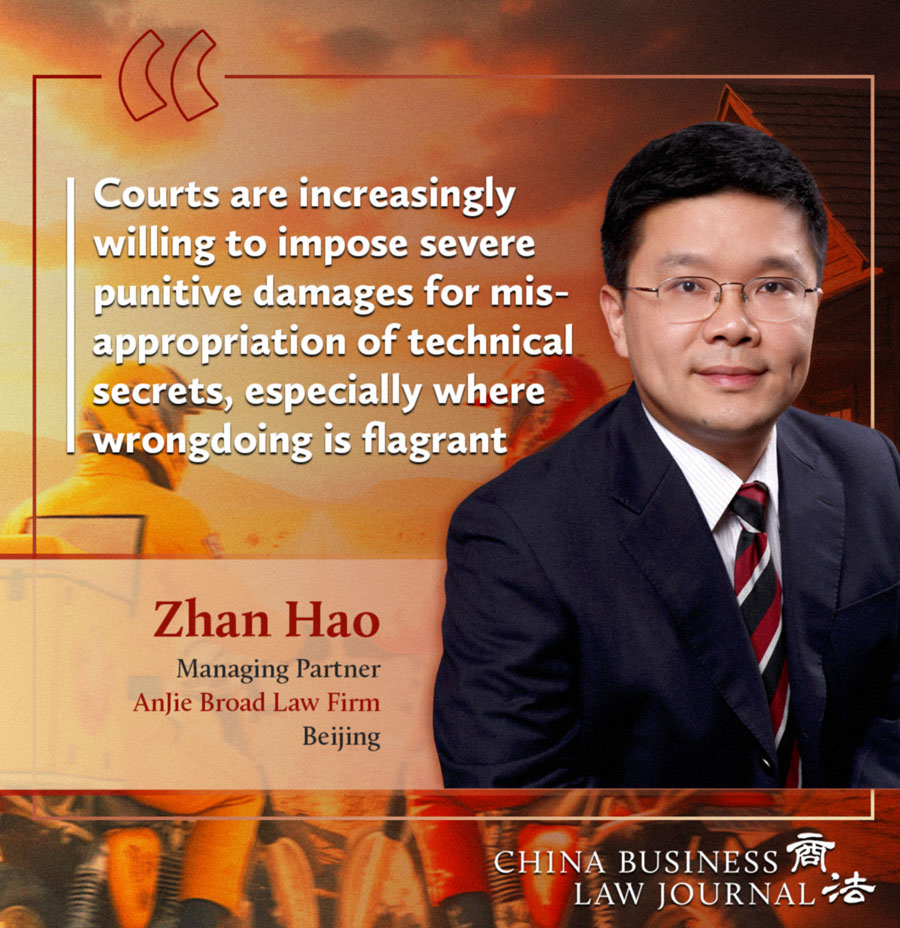
Signalling judicial priorities, the Supreme People’s Court released a batch of anti-unfair competition exemplary cases on 8 September 2025. From these cases, Zhan says, “courts are increasingly willing to impose severe punitive damages for misappropriation of technical secrets, especially where wrongdoing is flagrant”. One software-related case, for instance, led to damages of more than RMB166 million, substantially raising the stakes for infringement.
In the AI domain, a ruling has recognised a model’s parameters and structure as protectable competitive assets, extending legal safeguards into new territory.
Data rights and fair online conduct have also risen as regulatory priorities. Courts are penalising false or disparaging advertising more strictly, as seen in a vehicle maintenance case, and cracking down on imitation in livestream e-commerce.
Ultimately, curbing platform power and shifting from chaotic expansion to orderly growth remains central to digital governance. The revised law seeks to rebalance market power through stricter oversight, clearer red lines, and stiffer penalties.
But the law on the books is only a first step. True order will depend on consistent enforcement, coherence across regulations, and the system’s ability to adapt in practice – building, over time, a genuinely competitive and sustainable digital marketplace. 1.png)