





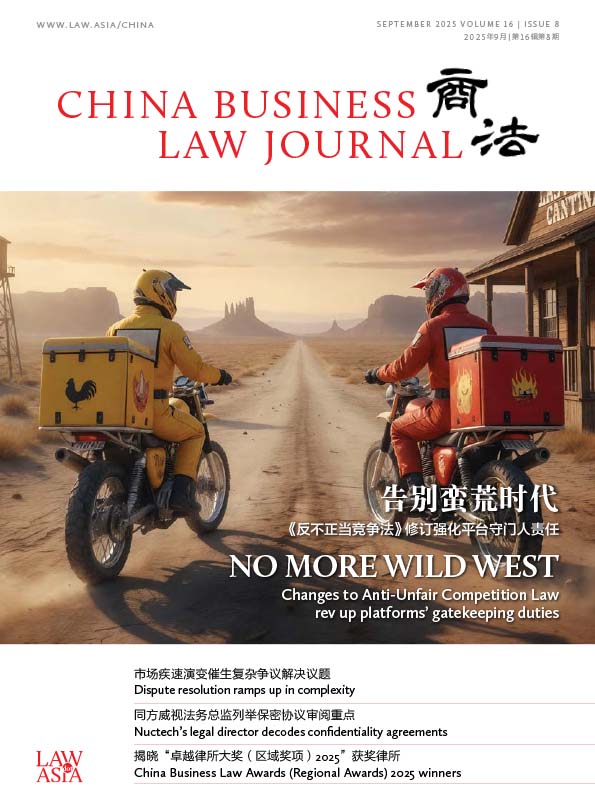


China Business Law Journal – March 2023
Volume 14, Issue 3
Subscribers can sign in to access the following PDF.
You must be a
subscribersubscribersubscribersubscriber
to read this content, please
subscribesubscribesubscribesubscribe
today.
For group subscribers, please click here to access.
Interested in group subscription? Please contact us.
你需要登录去解锁本文内容。欢迎注册账号。如果想阅读月刊所有文章,欢迎成为我们的订阅会员成为我们的订阅会员。
Highlights:
Re-examining the wooden barrel
Many of us are familiar with the wooden barrel theory and the classic teaching that “how much water a barrel can hold depends on the shortest wooden board”.
Business is the pursuit of perfection: the perfect product, perfect service – perfect barrel. But try hard as one might, there will inevitably be one area where one “board” falls shorter than others.
But perhaps that short board does not deserve contempt, as it also represents the richest opportunities for growth. Improvement in the weaker spots can often produce a more palpable effect than doubling down on existing strengths.
In this sense, few things are more valuable than direct feedback from clients, as they voice their needs, dissatisfactions, and areas where they hope to see improvement.
For law firms, such an opportunity presented itself with a recent survey on in-house counsel across Asia.
In our cover story, The Hit List, counsel share their opinions on why the legal services from some firms are less preferable than others, with poor communication, high prices and slow turnaround time ranked among their top complaints.
On the other hand, in-house legal teams are placing increasing emphasis on the use of legaltech to improve the efficiency of their day-to-day work. Consequently, there is a growing expectation that law firms should stay ahead of the curve in terms of applying the latest tools to provide the best services.
In the eastern coastal province of Jiangsu, the legal market has been benefitting from the Nanjing-based Third Circuit Court, an extension of the Supreme People’s Court, but the momentum has of late slowed down.
Riding on Blue ocean tides, law firms in Jiangsu are now seeking new avenues to maintain their legal market position in line with the province’s vigorous economic growth.
With an aim of protecting investors, regulations are beefing up for the disclosure requirements of listed companies, as well as their provision of security to third parties.
It falls to financial institutions, often acting as the creditors to such provision of security, to keep the numerous legal risks in check.
In Safety first, Dajia Asset Management’s general manager, Li Xinyang, and senior legal manager, Ye Qing, of the legal compliance and supervision department share their experience in risk control.
In other articles for our regular series of Expert Briefings, lawyers from various law firms discuss the legal risks associated with ChatGPT, a tricky scenario of handling a work-related injury after the employee’s departure, and the growing trend of designating entrusted loans not as private lending, but as financial loans, which comes with much stricter regulations.
In this issue


Action against malicious TM applicants and agencies
The China National Intellectual Property Administration (CNIPA) rejected 482,000 bad faith trademark filings in 2021, and made further efforts in 2022



















Safety first
Dajia counsel on new risks in security provision regulation